How to Clear Guttering
5 September 2026 Joe HartleyBeginner1–3 hours (depends on run length)10 comments
Tools
- Stable ladder and someone to foot it
- Stiff gutter scoop or gloved hands
- Bucket with a hook or line
- Garden hose (gentle flow)
- Brush for silt
- Gloves and eye protection
Blocked gutters overflow onto brickwork, soak fascia, and feed damp at the wall head. Clearing them is a height job first and a cleaning job second. If you cannot set a ladder on firm, level ground with a second person footing it, or the eaves are above a height you are happy working at, hire a gutter service rather than improvising from a roof.
Ladder rules before you scoop
- Firm, level base. Soft soil needs a board under the feet.
- Angle roughly one-out-to-four-up. Tie or footprint the ladder; do not work free-standing on uneven paving alone.
- Keep your belt buckle between the stiles. Move the ladder often instead of stretching along the run.
- Avoid overhead cables. Do not rest the ladder on plastic gutter as your only support if the bracket will crush.
- Stop in high wind or when surfaces are iced.
Working from the roof surface, leaning out over a void, or clearing three-storey runs without proper access equipment is where DIY should end. Call a pro for fragile roofs, fragile cast iron, or anything past a simple two-storey eaves you can reach safely.
What you are clearing
| Debris | Usual place | Notes |
|---|---|---|
| Leaves and moss | Along the trough | Scoop; do not shove toward the outlet |
| Grit and silt | At low points and stop-ends | Brush after the bulk is out |
| Nest material | Near outlets | Gloves; watch for sharp twigs |
| Broken seal scraps | At joints | Point to a gutter joint repair if water still weeps |
Plastic ogee and half-round systems are common on UK houses. Cast iron needs the same clearing but heavier sections and sharper edges; treat brackets as load-bearing, not handholds.
Clearing sequence
1. Set up under one bay at a time
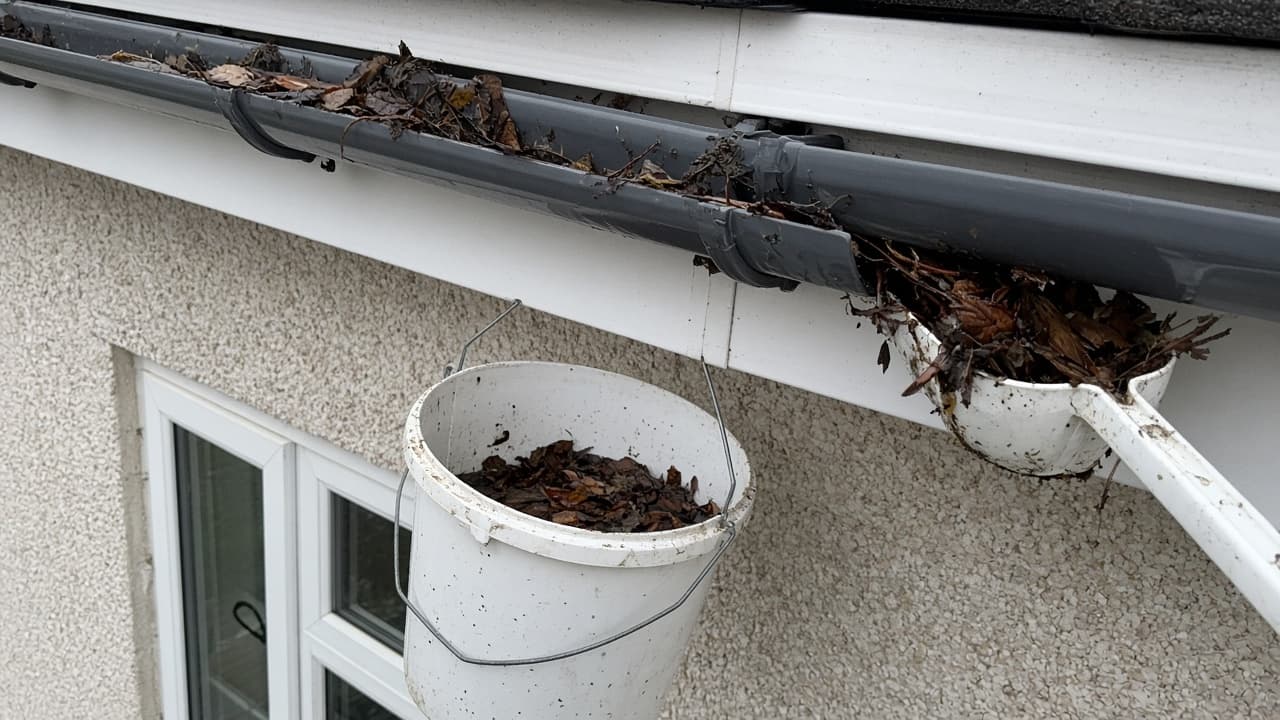
Hook a bucket on the ladder or lower debris in a bag. Start at a stop-end or the high point of the fall and work toward the outlet so you are not pushing silt into a clear downpipe.
2. Scoop, do not hose first
Lift wet leaves out. Hosing a packed trough first drives mush into the outlet and blocks the downpipe where you cannot see it. Gloves beat a flimsy plastic scoop that cracks on grit.
3. Open and check every outlet
The outlet into the downpipe collects the last handful of silt. Clear it by hand. Look down the pipe if you can; daylight or a clear drop means you are winning.
4. Flush gently
A slow hose from the high end should run to the outlet without spilling over the front edge. Puddles that linger mean the fall is wrong or a joint is holding water; clearing alone will not fix a sagging run.
5. Watch the downpipe discharge
Confirm water leaves at the shoe or gully, not from a mid-pipe joint. If the gutter is clear but the wall still wets in rain, the pipe may be blocked lower down or cracked. That leads into replace a downpipe.
Job-specific detail: The corner nearest a large tree often looks empty after a scoop while the outlet still holds a compacted plug the size of a fist. Probe the outlet with a gloved finger every time, even when the trough looks clean.
Mistakes that leave stains on the wall
- Stretching sideways from one ladder pitch until a bracket bends.
- Forcing debris down the pipe “to save a trip.”
- Standing on the gutter itself.
- Leaving silt at the stop-end so the next shower dumps it straight into the outlet.
- Ignoring a joint that drips after the trough is clean; clearing is not a substitute for a new seal.
When to call a gutter pro
Call in help for three-storey work, fragile roof coverings, cast systems with failed bolts, or if you need scaffolding. If overflows continue after a clear run, move on to leak diagnosis rather than endless scooping: fix a leaking gutter, replace a gutter joint, replace a downpipe.
FAQ
How often should I clear guttering in the UK?
Once a year is a minimum for most houses; twice if you sit under heavy leaf fall (oak, lime, nearby woodland). After autumn storms is the sensible main clear; a spring check catches nests and winter silt.
Can I clear gutters from the ground with telescopic tools?
Long-handled scoops help on single-storey runs if you can still see what you are doing. Blind scraping often misses the outlet plug. If you cannot inspect the trough and outlet properly, you need safe ladder access or a service.
Why does water still pour over the front after I cleared the leaves?
The outlet or downpipe may still be blocked, the gutter fall may be flat or back-fallen, or a joint may be open. Re-check outlets, flush slowly, and inspect brackets and seals rather than scooping the same leaves twice.
10 comments