How to Use a Multi-Tool for DIY
6 July 2026 Joe HartleyBeginner15–45 minutes per task16 comments
Tools
- Oscillating multi-tool
- Wood, metal, and plunge-cut blades
- Dust sheet and vacuum
- Hearing and eye protection
- Clamp or scrap gauge
An oscillating multi-tool is the awkward-space saw: architraves, flush nail heads, cutting out plasterboard, and trimming skirting where a circular saw will not fit. It shakes rather than spins. Force it like a jigsaw and you burn blades, wander off the line, or kick dust into your face.
Match the blade to the material
| Job | Blade type |
|---|---|
| Softwood frames, skirting, undercuts | Bi-metal or HCS wood blade |
| Nails, screws, thin metal | Bi-metal metal-cutting blade |
| Plasterboard plunge cuts | Plunge wood/board blade |
| Grout removal (light) | Carbide or diamond segment (not for structural tile cuts) |
Seat the blade fully on the tool’s mounts and lock it. A half-clicked blade walks, scores the work, and can shatter. Start on scrap so you feel the oscillation before you touch paintwork.
Wear eye and hearing protection while it runs. The same PPE habit applies on louder kit such as a mitre saw.
Where it earns its keep in a UK house
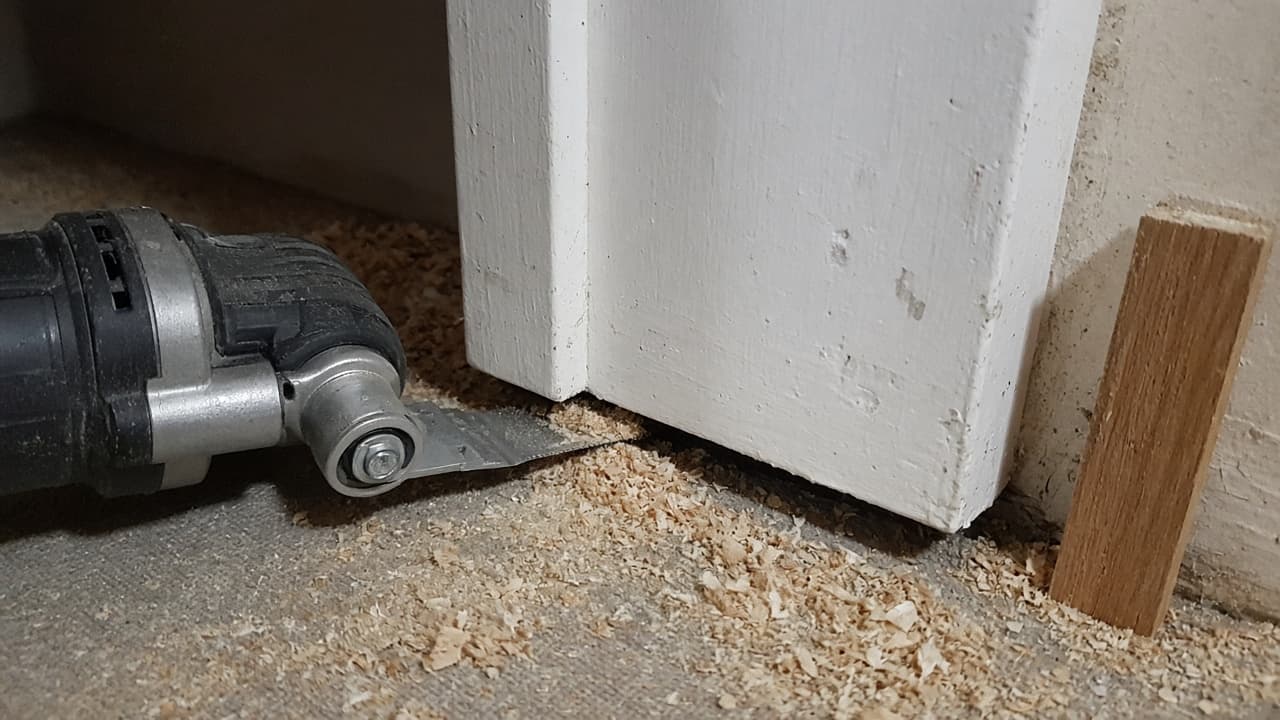
Common jobs: undercutting door linings for laminate, trimming a skirting toe for a new floor, cutting a neat rectangle in plasterboard for a back box, and flush-cutting proud pegs or nails. For flooring undercuts specifically, pair this tool guide with how to undercut door frames for flooring (use a scrap of underlay plus board as a height gauge under the blade).
It is not a substitute for a mitre saw on long accurate cross-cuts, or a circular saw on sheet materials. Those belong in how to use a mitre saw safely.
Step-by-step
1. Clear the area and mark the cut
Dust-sheet the floor. Mark the cut line clearly. On painted timber, score the paint line with a sharp knife first so the oscillating teeth do not lift a long flake of emulsion.
2. Set depth and support the workpiece
Many tools have a depth stop. Use it for undercuts so you do not bite into the jamb face. Rest the blade on a scrap gauge (flooring sandwich, or a packer of known thickness) when height matters. Clamp loose pieces; never freehand a small offcut against your knee.
3. Start the tool before the teeth bite
Bring the running blade to the work gently. Let the oscillation do the cutting. Pushing hard heats the blade and wanders the kerf. For plunge cuts in plasterboard, tip the blade in on the waste side of the line and expand the slot slowly.
4. Work in short passes
Pull out to clear dust, vacuum, then continue. On architraves, keep the shoe or blade flat so the cut stays parallel to the floor. Corners often need a sharp chisel to finish what the round blade cannot reach.
5. Change blades when they polish instead of cut
A blunt wood blade smears and smokes. Swap it. Do not “make do” through a whole hallway of frames with one tired blade.
Mistakes that chew the show face
- Forcing the tool so the blade flexes and digs a wavy slot.
- Skipping the paint score on gloss architraves.
- Using a wood blade on hidden nails until the teeth fold.
- Undercutting by eye instead of a real flooring gauge, then finding the board will not tuck under.
- Running without eye protection; fine dust and paint chips fly.
When to stop and use another tool (or a pro)
Stop if you hit live cables, unknown metal deep in a wall, or a fire-rated doorset you must not alter. Call an electrician for notifiable cable work, and a joiner if the frame is structural or listed joinery.
Related: how to use a mitre saw safely for accurate trim lengths, how to use a spirit level properly before you mark a run of cuts, and how to drill ceramic tiles without cracking when the next job is a fixing through glaze.
FAQ
What is an oscillating multi-tool best for?
Flush and plunge cuts in tight UK joinery: undercutting frames, trimming skirtings, cutting plasterboard openings, and flush-cutting fasteners. It is a precision awkward-space tool, not a demolition saw.
Can I undercut door frames with a multi-tool?
Yes. That is one of its best jobs. Set the blade height from a scrap of your actual underlay and flooring, then cut with the blade resting on that gauge. Full method: how to undercut door frames for flooring.
Why does my multi-tool blade burn the wood?
Usually too much pressure, a blunt blade, or running too long without clearing dust. Ease off, swap the blade, and take shorter passes.
16 comments