How to Use a Spirit Level Properly
25 August 2026 Joe HartleyBeginner10–20 minutes to learn12 comments
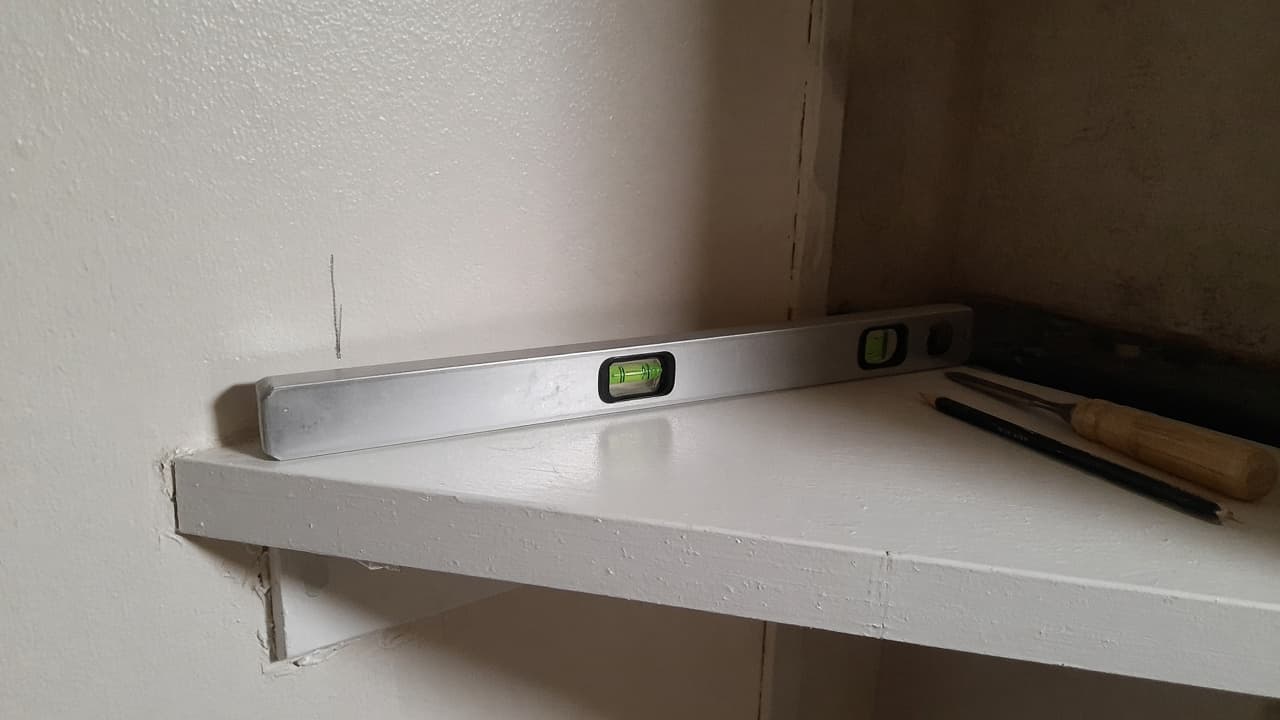
Tools
- Spirit level (torpedo or 600–1200 mm)
- Pencil
- Tape measure
A spirit level only helps if you trust the bubble and hold the tool flat against what you are checking. Most “wonky” shelves in UK homes come from reading the vial at an angle, using a short level across a long span, or trusting a knocked vial that no longer agrees with itself.
Which level for which job
| Length | Best for |
|---|---|
| Torpedo (about 200–250 mm) | Tight spaces: under sinks, inside frames, short brackets |
| 600 mm | Everyday shelves, sockets, short battens |
| 1200 mm (or longer) | Door linings, long shelves, checking floors and walls for run |
A longer level averages out dips. A short one can sit in a hollow and lie to you. Once the line is true and the fixing lands on glazed tile, see how to drill ceramic tiles without cracking.
Prove the vial before you trust it
Rest the level on a firm sill or worktop. Note where the bubble sits. Flip the level end-for-end (same face down). The bubble should land in the same place relative to the centre marks. If it disagrees, the vial is out or the body is bent. Do not hang a shelf from that tool until you replace it or use another level.
Wipe grit off the edges first. A grain of plaster under one end throws the reading more than most people expect.
Step-by-step
1. Hold the working edge hard against the surface
Press the long aluminium (or plastic) edge firmly onto the shelf, batten, or wall. Rocking or bridging a bump gives a false centre. On rough brick, use a straight timber batten as a bridge and level that instead.
2. Read the bubble square-on
Look at the vial from directly in front, not from above or to one side. Sideways viewing makes the bubble look centred when it is not. Centre the bubble between the two lines for level work. Use the end vials for plumb (vertical).
3. Mark only when the bubble is steady
Hold still for a second. Pencil a light line along the top of the level, or mark through the slots if your level has them. Recheck after you move the tool. On long runs, check at both ends and in the middle.
4. Check plumb the same way
For uprights (door linings, wall battens), use a plumb vial with the level hard against the face. Flip-test once on that edge too if the job matters. A lining that is level at the head but out of plumb on the jamb still binds a door.
5. Re-check after fixing
Drill and fix, then put the level back on. Screws often pull one end in. Loosen, pack, or re-fix before you load the shelf or hang the door.
Mistakes that leave things looking drunk
- Trusting a cheap level that fails the flip test.
- Using a torpedo across a 1.2 m shelf so the middle sits low.
- Reading the vial while standing to one side of a tall cupboard.
- Ignoring a bow in the wall and forcing a long shelf flat against it (pack behind brackets instead).
- Mixing “near enough” on consecutive brackets so the error stacks.
When to get help or change tools
If every level in the house disagrees, or you are setting structural work (load-bearing posts, large spans), hire or borrow a known-good long level, or use a laser for long runs. Do not trust a charity-shop special that failed the flip test.
Related kit skills: use a mitre saw safely, use a multi-tool for DIY, and drill ceramic tiles without cracking.
FAQ
How do I know if my spirit level is accurate?
Flip it end-for-end on the same surface. The bubble should read the same. If it does not, replace the level or stop using it for finish work.
Should I use a 600 mm or 1200 mm spirit level?
Use the longest level that fits the job. 600 mm is fine for short shelves. Door linings, long battens, and floor checks need 1200 mm or more so you do not chase local dips.
Why does the bubble look centred but the shelf still slopes?
You may be viewing from an angle, resting on debris, or checking only one bracket while the other sits high. Re-check both ends square-on with a clean edge, then load-test lightly.
12 comments