How to Hang an Internal Door
16 August 2026 Joe HartleyIntermediate2–4 hours11 comments
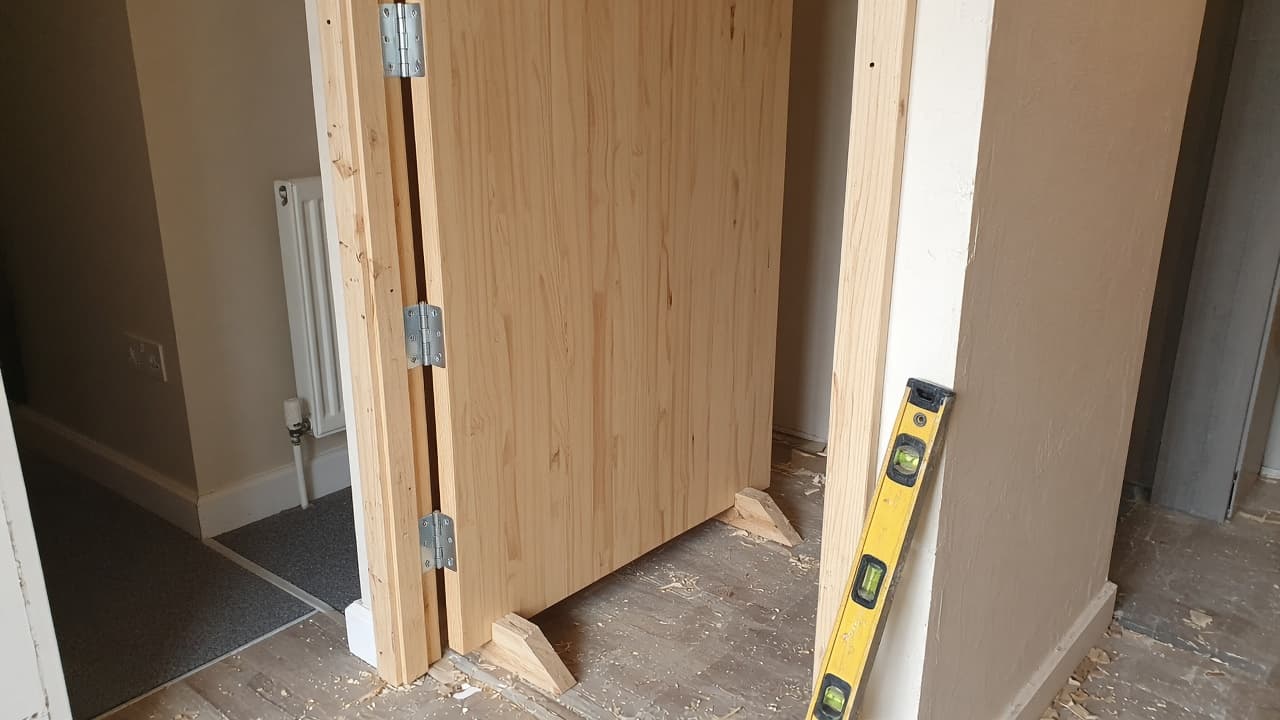
Tools
- Spirit level
- Tape measure and pencil
- Chisel and mallet
- Drill and screwdriver
- Plane or block plane
- Door wedges
Hanging an internal door is measuring, hinge recesses, and patience with the gaps. Get the latch edge clearance right and the door will close without slamming or binding. Rush the hinges and you will plane more wood than you meant to.
If the frame is already hinged and you are only swapping the leaf, use how to hang a door on existing hinges. For a full “door plus lining” job, see how to fit an internal door.
Choose the path
| Situation | Path |
|---|---|
| New door into a square, sound frame | This guide |
| New door into a twisted old frame | Hang a new door in an old frame |
| Leaf only, hinges stay on the lining | Existing hinges guide above |
| Door sticks after hanging | Check hinge packing and gaps; plane the high spot lightly if needed |
UK internal doors are commonly 1981 × 762 mm or 1981 × 686 mm (and metric neo-Georgian sizes). Measure the opening, not the old door alone. Allow roughly 2–3 mm at the latch edge and head, and enough at the bottom for flooring (often 10–15 mm over finished floor, more for thick carpet).
What you will need
| Item | Notes |
|---|---|
| Door and hinges | Match hinge size to the old recesses if reusing a frame |
| 75 mm or 100 mm butts | Common UK internal sizes; rising butts if clearing carpet |
| Latch and handles | 44 mm or 57 mm latch backset to match the door |
| Wedges | Hold the leaf while you mark and screw |
| Sharp chisel | Pair of hinges needs clean recesses, not chewed plywood |
Step-by-step
1. Check the frame
Sight the lining with a spirit level on hinge jamb, latch jamb, and head. If the frame is more than a few millimetres out of plumb or the opening is diamond-shaped, stop and follow the old-frame guide. Offer the door into the opening on wedges and confirm height and width before you cut anything.
2. Mark hinge positions
Standard pattern: top hinge about 150 mm down from the top of the door, bottom hinge about 225 mm up from the bottom. A third hinge mid-way on heavy or fire doors. Transfer marks to the jamb so leaf and lining match. Score the hinge outline with a knife so the chisel does not tear the face veneer.
3. Cut hinge recesses
Chop to the thickness of the hinge leaf so the hinge sits flush, not proud. A proud hinge is a classic bind on the hinge edge. Drill pilot holes for every screw; softwood linings strip if you drive 4 mm screws without pilots.
4. Hang and set gaps
Screw hinges to the door first, then offer the door into the frame on wedges and screw to the jamb. Check the latch edge gap is even top to bottom. Adjust by packing behind a hinge leaf or planing the latch edge lightly. Full planing method: how to plane a door that sticks.
5. Fit latch and strike
Mark the latch height from the handle set. Bore for the latch body, cut the faceplate flush, then close the door onto a scrap of card to mark the strike on the jamb. Chisel the keep recess so the latch clicks home without forcing the door.
Mistakes that leave a door that never sits right
- Cutting hinge recesses too deep so the door pulls hard onto the stop.
- Measuring bottom clearance before the finished floor is decided.
- Skipping pilot holes in MDF or soft lining.
- Planing the hinge edge instead of resetting hinges when the rub is on that side.
When to call a joiner
Stop if the opening needs a new lining, if you are into a fire door with intumescent seals you are not confident marking, or if the wall above the opening looks unsupported (never cut a structural opening without proper support). Cost context: cost to hang an internal door DIY vs joiner.
Same cluster: how to fit door hinges correctly, how to cut a door to size.
FAQ
What order should I hang an internal door in?
Check the frame is square, cut matching hinge recesses in door and jamb, hang on wedges, set even latch-edge gaps, then fit latch and strike. Measure for the finished floor before you shorten the leaf.
How long does hanging an internal door take?
A straightforward swap in a square frame is often a morning. An out-of-square frame or a door that needs heavy cutting runs into an afternoon.
Do I need three hinges?
Two butts are fine on a light hollow-core door. Use three on solid, glazed, or fire doors, or if the manufacturer specifies it.
11 comments