How to Fit Door Hinges Correctly
28 July 2026 Joe HartleyIntermediate1–2 hours18 comments
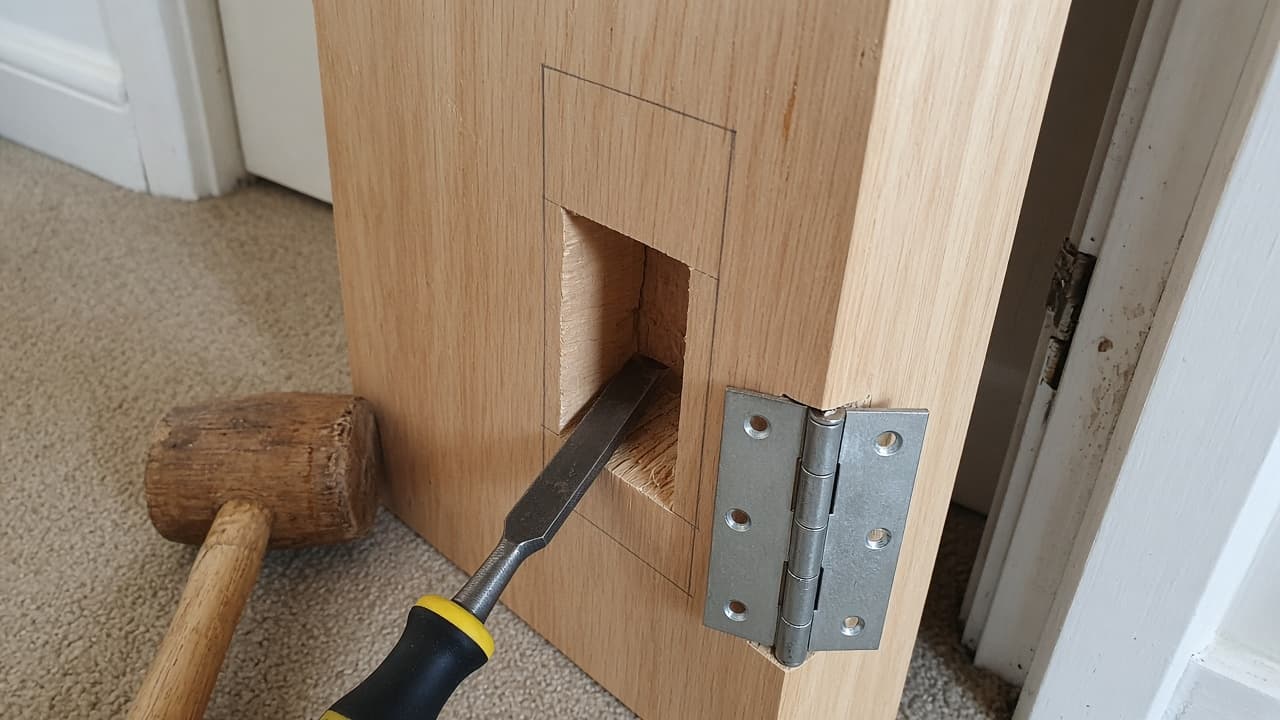
Tools
- Tape, pencil, and combination square
- Marking knife
- Sharp chisel and mallet
- Drill with pilot bit
- Screwdriver
Fitting door hinges correctly is recess depth and matching positions, not just screwing butts onto the edge. A hinge sitting proud binds on the hinge side. A recess cut too deep pulls the leaf hard onto the stop.
This is the hinge detail inside how to hang an internal door. For carpet clearance that lifts as the door opens, use how to fit rising butt hinges instead of ordinary butts.
Butt size and position
| Choice | Typical UK internal practice |
|---|---|
| Hinge size | 75 mm or 100 mm butts to match old recesses if reusing a frame |
| Top hinge | About 150 mm down from the top of the door |
| Bottom hinge | About 225 mm up from the bottom |
| Third hinge | Mid-way on solid, glazed, or fire doors |
| Screws | Match hinge holes; pilots in softwood and MDF linings |
Knuckles should sit just clear of the door face so the leaf can swing past the lining. If you are only swapping a leaf and the jamb leaves stay, see how to hang a door on existing hinges.
Kit for hinge recesses
| Item | Notes |
|---|---|
| Pair (or set) of butts | Same brand and knuckle pattern on one door |
| Sharp chisel | Width close to the hinge leaf helps cleanliness |
| Marking knife | Scores veneer before the chisel tears it |
| Packing card | Thin pack behind a leaf to nudge gaps later |
| Door wedges | Hold the leaf while you transfer marks |
Step-by-step
1. Decide knuckle direction and hand
Stand where the door will open toward you. Butts are usually fitted with knuckles proud of the door face on the opening side. Mark hinge edge clearly so you do not cut recesses on the latch stile by mistake.
2. Mark matching positions on door and jamb
Set the top and bottom distances, then transfer each hinge outline to the jamb with the door offered on wedges, or with a story stick. Gauge the recess depth from the hinge leaf thickness. Score the outline with a knife; pencil alone lets the chisel wander into the face veneer.
3. Chop recesses flush, not proud
Pare across the grain in thin stages until the hinge leaf sits fully in, flush with the door edge. Check with a straightedge. Leave the knuckle proud as designed. Drill a pilot for every screw; softwood linings strip quickly if you force 4 mm screws cold.
4. Screw door leaves first, then jamb
Fit hinges to the door, offer the leaf into the opening on wedges, and fix to the jamb. Check latch-edge gap top to bottom. Pack behind a hinge leaf with thin card if one corner sits tight; do not plane the hinge edge as your first fix (how to plane a door that sticks is for marked high spots after hinges are honest).
5. Retest swing and stop contact
Open and close slowly. Rub on the hinge side usually means a proud leaf or shallow recess. Rub after seasonal weather may be latch-edge swell; diagnose before you cut more timber (how to fix a sticking door).
Mistakes that bind on the knuckle
- Recesses deeper than the leaf so the door is sucked onto the stop.
- Skipping pilots and spinning screws in MDF linings.
- Mixing rising and non-rising butts on one leaf.
- Transferring only one hinge accurately and “eyeballing” the second.
When to stop and get help
Call a joiner for fire-door hinge patterns and intumescent pads, for linings too rotten to hold screws, or when the opening needs a new lining (how to fit an internal door). Twisted frames need a different approach: how to hang a new door in an old frame.
Same cluster: how to cut a door to size, cost to hang an internal door DIY vs joiner.
FAQ
How deep should a hinge recess be?
Match the hinge leaf thickness so the leaf sits flush with the door edge, knuckle proud as designed. Mark matched positions on door and jamb, score the outlines, chisel carefully, pilot every screw, then hang on wedges and pack for even gaps.
Why does my door bind on the hinge side?
Usually a hinge leaf sitting proud, a shallow recess, or a bowed hinge jamb. Deepen or reset the recess; packing the opposite hinge can also open the gap slightly.
Do I need three hinges on an internal door?
Two butts suit many light hollow-core doors. Use three on heavier solid or glazed leaves, or where the maker specifies it.
18 comments